
Fibre & Fullness
The Fibre Record: How Plant Foods Shape Midday Hunger
Eleanor Whitfield · 14 January 2026

London, 11 February 2026. Three afternoon sessions across a February working week, each anchored by a midday meal constructed around a different protein source. The question was not which protein is superior, but how each shaped the hours that followed — the quality of the afternoon, the moment hunger returned, the degree to which the plate at noon determined the character of the day after it.
The afternoon is the segment of the working day most likely to be shaped by what was eaten at midday. This is not a controversial observation. What is perhaps less examined is how different protein sources — and the food arrangements that surround them — produce noticeably different qualities of afternoon, even when the caloric content of the midday meal is comparable across days.
This record does not deal in numbers. No portion weights were measured, no macronutrient ratios calculated. The observation is qualitative: how did the body register the meal, and at what point did appetite and food timing reassert themselves as the dominant concern of the hour?
Three sessions were chosen for this log. The first centred on eggs and soft-cooked pulses. The second on oily fish alongside a grain-rich salad. The third on a plate built entirely from plant sources — legumes, seeds, and fermented vegetables. Each was eaten slowly, at a table, without distraction. Each afternoon that followed was attended to as a field log.
The first session, on a Tuesday, took the form of a warm bowl: two poached eggs resting on a bed of cooked Puy lentils, with a quantity of roasted red onion, a handful of watercress added at the last moment, and a dressing of lemon and olive oil. The meal was assembled without ceremony — a functional midday arrangement rather than a production — and eaten in approximately eighteen minutes.
The eggs contribute to a sense of satiety through multiple channels: the protein content, the fat content of the yolk, and the structural density of a cooked egg white that the digestive process works through at a different pace than liquid or softened foods. The lentils, meanwhile, are slow in their own register — a fibre-dense legume that extends the period of digestive engagement.
By 15:30, there had been no meaningful visit from hunger. A cup of tea had been made around 14:45, but this was habitual rather than appetitive. At 16:00, a gentle awareness of readiness for food arrived — mild and negotiable, not pressing. The afternoon had passed with the quality of sustained focus that tends to be associated with adequate and appropriate nourishment.
The second session, on Thursday of the same week, took a different form. A fillet of grilled mackerel, its skin crisped against the heat, was placed alongside a salad of cooked farro, shaved fennel, preserved lemon, and a scattering of capers. The meal was larger in apparent volume than the first session's bowl, though not markedly heavier in character when eaten.
Mackerel is a protein-rich food with a notable fat content — the oils that give it its richness are also part of what slows the pace at which the stomach clears. Paired with farro, one of the slower grains by digestive measure, the combination produced an afternoon of particular stillness, appetite-wise. The record notes no awareness of hunger until shortly after 17:00 — an interval of approximately five hours from the end of the meal.
The quality of this particular afternoon was notable for another reason. The absence of the slow hunger hum — that low background awareness of the body's readiness for food that tends to colonise the 15:00-16:30 window — permitted a longer uninterrupted span of attention. This is not a claim about cognitive enhancement. It is a description of what the afternoon felt like: quieter, in the particular sense that the body was not making requests.

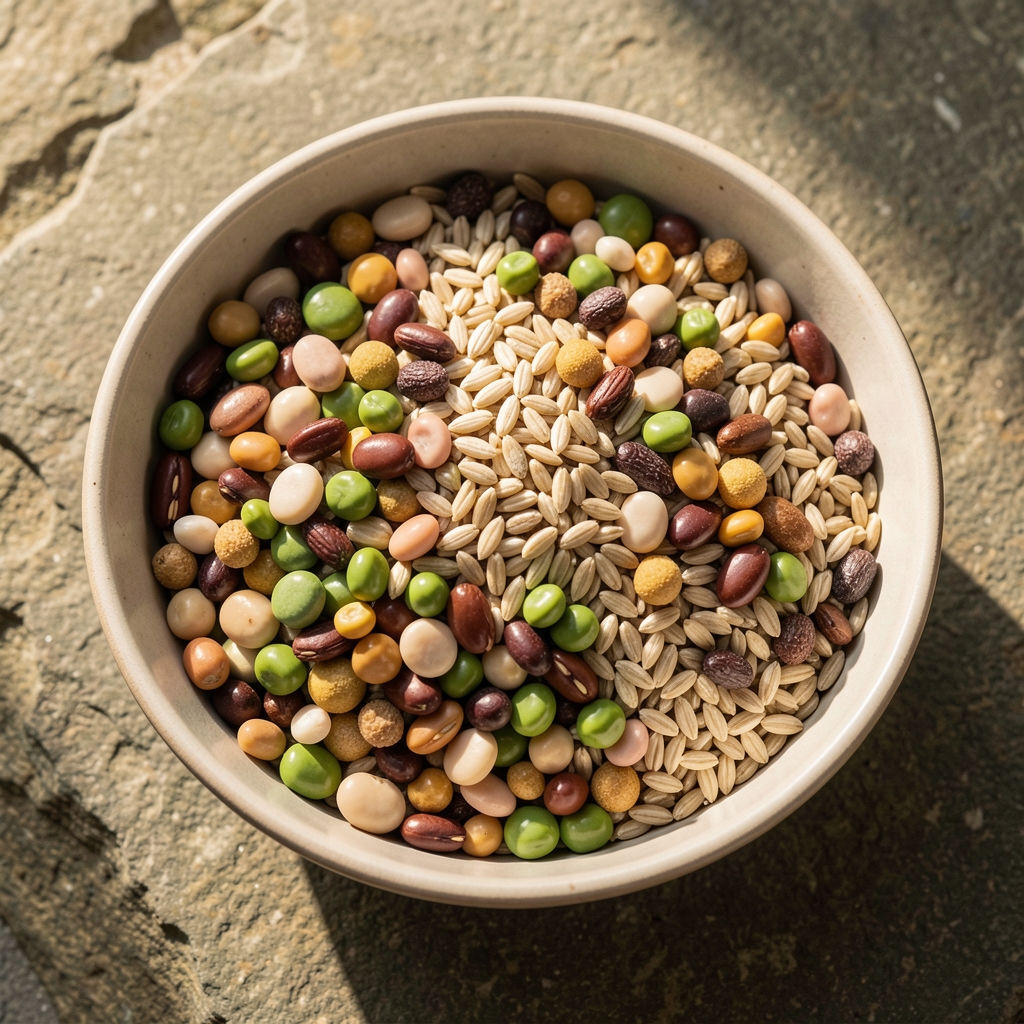
The third session departed from animal protein entirely. The plate was constructed from a base of cooked black beans and beluga lentils, topped with a generous portion of roasted squash, a spoonful of tahini loosened with water and garlic, and a side of fermented cabbage. Seeds — hemp and pumpkin — were scattered over the top for textural contrast and for what they contribute to the overall nutritional composition of the arrangement.
Plant-based satiety operates through slightly different mechanics than the satiety produced by animal proteins. The combination of legumes and seeds covers the protein contribution through complementary patterns. The fibre density of the beans and the squash contributes to the slow-digesting quality that extends the satiety window. The fermented element, while not a direct factor in fullness, adds a complexity to the eating experience that tends to slow the pace of the meal itself — and pace, as this record has noted before, is itself a variable.
The afternoon after this session was the longest without hunger of the three. An awareness of appetite arrived around 17:15, mild in character, easily deferred to the evening meal. This was not a dramatic difference from the other sessions. The point is not drama but pattern: a pattern that places plant-based fullness squarely within the same range of effectiveness as the animal-protein arrangements tested on the preceding days.
A variable that appeared consistently across all three sessions was pace. Each meal was eaten slowly — deliberately so, not as an act of restraint, but as a condition of observation. A meal eaten at pace allows natural fullness signals to register before the plate is cleared, which alters the relationship between the quantity consumed and the sense of completion the meal produces.
This is not a recommendation for a particular speed of eating. It is an observation that pace is a factor in how protein and fullness interact — that the same food eaten quickly produces a different afternoon than the same food eaten with attention. Mindful eating pace is perhaps an overly fashionable phrase for what is, at its core, a straightforward observation: the body needs time to register what it has received.
The three sessions documented here were not controlled experiments. They were field notes — attended observations on the relationship between food choices at midday and the character of the hours that follow. The pattern that emerged was consistent enough to be worth recording: protein-anchored midday plates, eaten at a pace that permits the meal's fullness to register, tend to produce afternoons in which appetite occupies a smaller proportion of the available attention.
One further observation deserves a place in this record. On the days that followed these three sessions, snacking habits in the afternoon window — the 15:00 to 17:30 period — were markedly reduced compared to the preceding weeks. A biscuit taken with a second cup of tea, a piece of fruit eaten more from habit than appetite, the reaching for something small around 16:00 as a form of punctuation: these behaviours, familiar from many an ordinary working afternoon, were largely absent.
This is not a negligible observation. The afternoon snacking pattern is not, in most people's experience, a response to acute hunger. It is a response to a low-level background appetite that builds gradually and eventually tips into decisive action. When the midday plate has been adequate in its protein contribution and eaten at a pace that permits the fullness to settle, that background signal arrives later, more quietly, and less insistently. The afternoon remains available, rather than being slowly colonised by the anticipation of the next meal.
Three sessions, three protein arrangements, three afternoons attended to as a form of observation. The record does not offer conclusions, only a shape — a pattern that suggests that the question of foods that keep you full is, in part, a question of how the midday hour is approached and what it contains.
Tobias Marsden writes on food, appetite, and the everyday patterns of eating. His field notes for Aldoran Letters focus on the relationship between protein, satiety, and the rhythm of the working day. Based in London.